CRM for Cultural Nonprofits
How to pick a customer relationship management platform that fits how cultural nonprofits actually work, from annual appeals to event ticketing.
A CRM for cultural nonprofits is a single system for donors, members, event and program registration, ticketing, and volunteers. Sector-fit CRMs outperform generic donor databases for cultural nonprofits that run any meaningful earned-revenue operation.
Why cultural nonprofits need purpose-built CRM
Cultural nonprofits (historical societies, community arts organizations, chorales, small theater companies, cultural centers) share a shape: a household-based donor and member base, program and event registrations, some earned revenue from tickets or rentals, and a very small staff carrying all of it. A CRM designed only for donor management leaves the earned-revenue side unmanaged. A CRM designed only for ticketing leaves the donor side unmanaged. Cultural nonprofits need both, on the same record.
Key capabilities to look for in a cultural nonprofit CRM
Five capabilities separate a real cultural nonprofit CRM from a general-purpose sales or nonprofit tool. If a vendor cannot demo all five on real customer data, keep looking.
Donor management for annual, capital, and planned giving
Annual funds, capital campaigns, giving societies, planned giving, memorial gifts, and grants all belong on the same household record. Moves management, batch entry, and gift receipting should be efficient enough for a two-person development team.
Membership with tiered benefits
Household memberships with named cardholders, auto-renew, upgrade paths, and a lapsed re-engagement flow. Members should never receive two renewal notices at the same address.
Event and program registration
Performances, lectures, exhibitions openings, cultural celebrations, and educational programs should all share the same registration flow, capacity, and waitlist mechanics.
Volunteer scheduling and hours tracking
Volunteers are usually the largest constituent group at a cultural nonprofit, and often overlap with the donor base. The CRM should schedule shifts, track hours, and roll volunteer contributions into the same profile.
Website integration and payments
Members, donors, and ticket-buyers should be able to complete every transaction on your website, not redirected off-site. Payments processing at reasonable rates is a first-order cost lever.

How SocialGood Software approaches CRM for cultural nonprofits
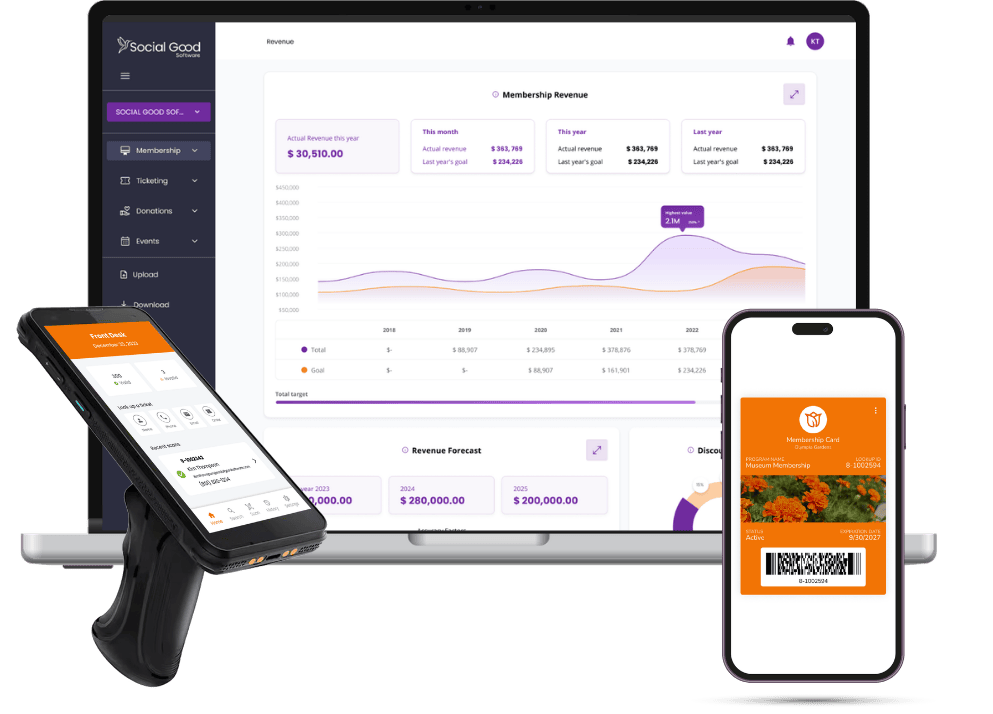
SocialGood Software fits cultural nonprofits that need the earned-revenue side and the fundraising side on the same record without having to buy an enterprise platform. If you want to see it work for a cultural nonprofit like yours, our team runs a live demo in about 30 minutes: explore the CRM module or book a walk-through.
Common pitfalls to avoid
The most common cultural-nonprofit CRM mistake is picking a donor-only tool (Bloomerang, DonorPerfect, Little Green Light) and later trying to bolt on events, memberships, or ticketing. The alternative mistake is picking a ticketing-only tool that lacks a real donor record. Both leave you paying for two systems that do not quite talk.
Frequently asked questions
What is the best CRM for a cultural nonprofit?
The best CRM for a cultural nonprofit is one that combines donor management, memberships, event and program registration, and volunteer scheduling on a single household record. Small cultural nonprofits often benefit most from sector-fit platforms designed for cultural attractions.
How much does a cultural nonprofit CRM cost?
Small cultural nonprofits spend $3,000 to $15,000 per year; mid-sized organizations $12,000 to $40,000. The right platform usually pays for itself in reduced admin time and higher renewal rates.
Should we use a donor-only tool or a full CRM?
If your organization has any meaningful earned revenue (tickets, rentals, program fees, memberships), a full CRM will serve you better than a donor-only tool. If you truly only fundraise, a donor-only tool may be enough.
Can we run our cultural nonprofit on QuickBooks and Google Sheets?
You can, for a while. Most cultural nonprofits hit a ceiling once membership or the annual appeal crosses a few hundred households, and the reconciliation cost starts to exceed the software cost.
How long does a cultural nonprofit CRM migration take?
Sixty to one hundred twenty days is typical. Data volume is usually modest; the pacing item is staff and board sign-off on renewal, appeal, and receipt templates.
What integrations should we look for?
Two-way sync with an email marketing platform, payments processing, calendar sync for volunteers and events, and finance-system export are baseline. Ask vendors for reference cultural nonprofits of your size.