FOR IMMEDIATE RELEASE
Media contact: Tim Cooley
tim@socialgoodsoftware.com
801-822-0183
SocialGood.com
As public garden leaders, executive directors, and development professionals gather in San Francisco for the APGA Annual Conference, the overarching theme across the sector is innovation. However, true innovation in the arts and cultural space cannot be limited to physical curation or exhibit design. To build a resilient future, institutions must also innovate the operational and financial engines that keep their gates open.
For decades, the standard funding model for cultural institutions has leaned heavily on grant acquisition. While grants are an invaluable resource for specific projects, relying on them as a core operational strategy introduces significant organizational vulnerability. When an institution depends on cyclical funding, its internal stability is tied directly to external variables.
To achieve long-term security, predictability, and growth, forward-thinking gardens are diversifying their revenue. By moving away from grant dependency and implementing specialized software solutions for arts and cultural organizations, public gardens can establish a proactive financial framework built on the “Three R’s”: Revenue, Retention, and Reporting.
The Operational Friction of Grant Dependency
To understand why a strategic pivot is necessary, it is important to analyze the administrative and financial costs associated with traditional fundraising. Data compiled by the Urban Institute indicates that the typical arts and culture nonprofit operates on a narrow 2.24% operating surplus. Alarmingly, the same data reveals that without grant funding, these institutions would face an average -15.56% deficit.
Beyond financial volatility, grant acquisition demands a massive investment of institutional labor:
- The Administrative Burden: Research from PEAK Grantmaking (Project Streamline) shows that a single foundation grant requires an average of 48 hours of staff labor split between application creation and compliance reporting.
- The Time Sink: A study by the Rand Corporation found that some nonprofit organizations spend up to 44% of their total organizational time and 11% of their operational budgets simply managing funder data requests and reports.
- The Risk Factor: Peer-reviewed analysis published in PLOS ONE tracking competitive funding proposals discovered that the sheer number of hours poured into complex grant applications has no statistical correlation to whether the project is ultimately funded.
When senior leadership capital is consistently spent looking backward to satisfy retroactive reporting requirements, organizations lose the capacity to plan proactively.
The Sustainable Framework: The Three R’s
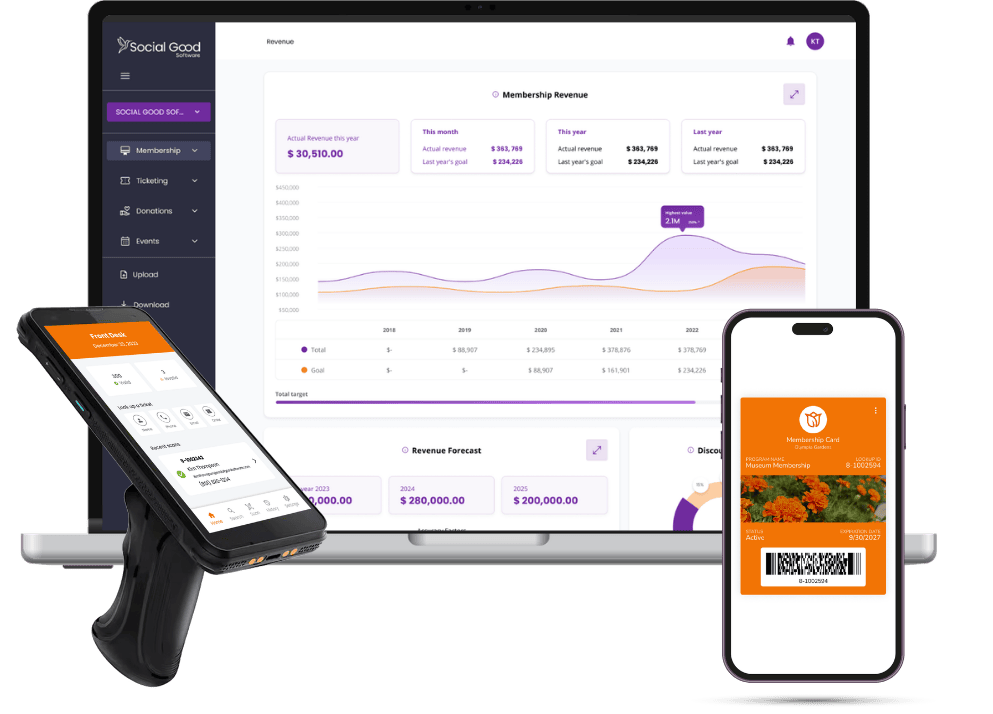
To transition from reactive fundraising to predictable revenue generation, institutions require integrated public garden management software. This digital infrastructure secures operations across three key pillars:
Revenue Optimization
Maximizing earned income is not about commercializing a garden’s mission; it is about removing the digital friction that prevents interested visitors from fully engaging. Unified software systems optimize the transaction experience in three ways:
- Frictionless Conversion: Industry benchmarks indicate that convoluted online checkout paths cause up to 60% of prospective buyers to abandon their carts. Streamlining the click-through rate captures existing demand.
- Amplifying Generosity: Introducing automated, mission-aligned micro-donations at the point of checkout naturally increases average cart value while the guest is at peak emotional alignment.
- Intelligent Upselling: Modern platforms automatically recognize when a visitor is purchasing a ticket package that mirrors the cost of a membership, presenting a seamless opportunity to upgrade before checkout is finalized.
Strategic Retention
Data from the Fundraising Effectiveness Project (FEP) reveals that first-time donor retention in the cultural space hovers at a baseline of 19%. Conversely, the retention rate for recurring members and monthly givers increases to 87% or higher.
The key to unlocking this predictability is a dedicated non-profit member portal. When a member has access to a 24/7 self-service digital hub, they can instantly download digital cards, manage renewals, or share guest passes from home. Providing this seamless utility establishes a continuous off-site connection, leveraging the principle of reciprocity to organically transition casual visitors into multi-year givers.
Present-Focused Reporting
Traditional reporting often acts as a post-mortem autopsy, evaluating spreadsheets weeks after an event has concluded when it is already too late to shift variables. Sustainable growth requires real-time dashboards that measure live operational velocity.
Consider our partners at Filoli Gardens. By tracking live transaction velocity, their leadership team possessed the data-driven confidence to scale their seasonal Nightfall event from an initial 300-person pilot into a major public program welcoming over 58,000 guests. Unified reporting also surfaces predictive indicators, alerting development teams when a high-tier member’s digital engagement drops so they can re-engage them before quiet churn occurs. Finally, automating these workflows liberates staff from data drudgery, reducing turnover and maximizing operational efficiency.
Partnering for the Future
Technology should serve as an invisible trellis, a stable, underlying framework designed entirely to support and elevate the human mission of your institution.
At Social Good Software, we are always excited to connect with gardens to listen and learn about what their goals are to grow and become financially stable. Whether you are attending the APGA conference or evaluating your digital architecture from your home office, we are here to support your roadmap.
Please reach out to our team today or visit our educational booth at the APGA Annual Conference to share your goals and explore sustainable solutions for your organization.